
In Toronto’s diverse architectural landscape—from the Victorian row houses of Cabbagetown to the ultra-modern custom builds in North York—exterior design is evolving. The flat, one-dimensional privacy fence is being replaced by a material that offers depth, rhythm, and resilience: Fluted Fencing.
For homeowners, builders, and architects alike, the goal is no longer just “privacy.” It is about creating a visual statement that withstands the Canadian climate. At Wiedehopf, we specialize in high-performance WPC (Wood Plastic Composite) panels that bridge the gap between architectural beauty and practical durability.
In this guide, we explore why fluted composite panels are becoming the top choice for Canadian exteriors and answer the critical questions professionals and homeowners are asking.
What is Fluted Fencing?
Fluted fencing refers to panels that feature a ribbed, grooved, or scalloped surface pattern. Unlike traditional flat planks, “fluted” designs utilize vertical lines to create a sense of height and elegance.
This linear texture plays with light and shadow. As the sun moves across the Toronto sky, the ridges on a fluted fence cast shifting shadows, giving the wall a dynamic, 3D appearance. This interplay of light and material is a core principle of modern design, transforming a simple boundary wall into a feature of the home.
 The Aesthetic: From White Oak to Matte Black
One of the primary questions we receive from designers is regarding the finish. Can a composite material truly replace the look of natural timber?
Traditional wood requires specific species to achieve certain looks, and maintaining those looks is a constant battle against the elements. Wiedehopf WPC panels are engineered to replicate the most sought-after natural hardwoods and modern tones without the ecological cost or maintenance:
- The “White Oak” Look: Currently a top trend in Toronto interior and exterior design, real White Oak is expensive and water-sensitive. Our composite captures that pale, sandy warmth that brightens up a backyard, offering a Scandinavian aesthetic.
- The “Ipe & Walnut” Look: Dark, rich woods like Ipe or Black Walnut are luxury staples. Our panels mimic these deep, chocolate tones, providing a sophisticated backdrop for garden greenery.
- The “Western Red Cedar” Look: The classic Canadian fence choice. Our composite captures the reddish-gold hues of fresh cedar but locks that color in, preventing the “silver-grey” drift that happens to real cedar within 12 months.
- Modern Monochromes: For a bold, architectural statement, we offer Matte Black and Charcoal. Unlike painted wood, which peels, or stained wood, which fades, these solid colors remain deep and consistent.
 WPC vs. The Alternatives: A Comparative Look
When planning a project in the GTA, you are likely weighing several options. Here is how Composite Fluted panels stack up against traditional materials.
Pressure-Treated Lumber vs. WPC
While pressure-treated wood is the most affordable option upfront, it is chemically treated and prone to severe warping and twisting within the first year. WPC panels are engineered for stability; they do not twist, ensuring your fluted lines remain perfectly straight year after year.
Western Red Cedar vs. WPC
Cedar is the gold standard for natural wood fencing in Canada. However, it requires staining every 2-3 years to maintain its color. WPC provides the warm aesthetic of fresh cedar without the biennial maintenance costs and labor.
PVC/Vinyl vs. WPC
This is a common point of confusion. PVC (Vinyl) is often hollow, lightweight, and has a shiny, plastic appearance. WPC (Wood Plastic Composite) is a blend of wood fibers and thermoplastics. The addition of wood fiber gives the board weight, density, and a matte texture that mimics organic timber. It feels substantial, like a hardwood plank, rather than a hollow shell.
Frequently Asked Questions (FAQ) & Common Misconceptions
There are many opinions surrounding composite wood materials. Here, we address the most frequent concerns raised by homeowners and builders to help you make an informed decision.
Q: “Does composite fencing feel flimsy?”
The Reality: High-quality WPC is dense and heavy. When users report “flimsiness,” it is almost exclusively an issue with the installation method or the use of low-grade, hollow PVC products. The Solution: Wiedehopf panels are designed to be robust. When installed using proper aluminum or steel posts, rather than sliding them over rotting wood 4x4s, the fence is rock solid. The structural integrity comes from the combination of a high-quality panel and a professional installation system.
Q: “Will the fluted grooves collect dust?”
The Reality: Any textured surface, whether it is wood louvers or fluted composite, can catch dust and pollen more than a flat board. The Solution: The advantage of WPC is that it is hydrophobic (water-resistant). Unlike wood, which can be damaged by high-pressure washing, WPC can be easily cleaned. A quick spray down with a garden hose once a season is usually all that is required to wash dust out of the grooves.
Q: “Is it expensive compared to wood?”
The Reality: The upfront cost of WPC is higher than pressure-treated lumber and comparable to high-grade cedar. The ROI: However, when calculating the “true cost,” you must factor in maintenance. A wood fence requires cleaning, sanding, and staining ($500-$1000+) every two to three years. Over a 10-year period, WPC often becomes the more cost-effective option because the maintenance cost is effectively zero.
Built for the Canadian Climate
Toronto experiences extreme temperature fluctuations, from humid summers to freezing winters. This environment is brutal on traditional materials.
- Freeze-Thaw Resistance: Traditional wood absorbs water. When that water freezes, it expands, causing the wood to crack and warp. WPC panels are engineered to have low water absorption. For a deeper understanding of how composite materials resist environmental stress, you can read about the mechanical properties of wood-plastic composites on ScienceDirect, which details how thermoplastic bonding prevents moisture intrusion.
- UV Stability: While cheap plastics fade to a chalky white, Wiedehopf composite panels are engineered with UV inhibitors. You may see a slight, uniform settling of the tone in the first few weeks as the product acclimatizes, but the color then stabilizes for the life of the product.
For more information on how building materials are tested for Canadian weather resilience, the National Research Council of Canada provides extensive resources on construction standards and material durability in northern climates.
A Note for Architects and Builders
If you are designing a custom home or managing a build, the versatility of fluted WPC is a key advantage.
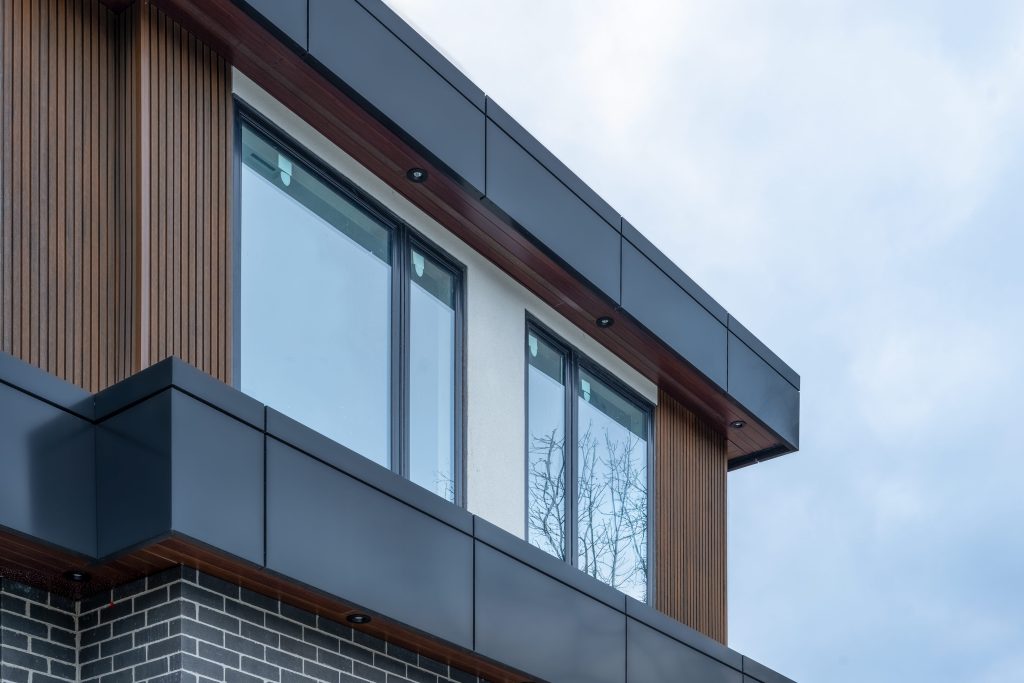
- Cladding & Siding: These panels are not limited to property lines. They are excellent for exterior wall Fluted cladding, soffits, and accent walls. This allows you to carry the design language from the fence onto the house itself, creating a cohesive “streetscape.”
- Hidden Fasteners: Wiedehopf panels typically utilize a tongue-and-groove or clip system. This means no visible screws disrupting the clean, vertical lines of the fluted profile, satisfying the most demanding modern design specifications.
Conclusion
Fluted fencing is more than just a trend; it is a practical evolution of exterior design. By choosing Wiedehopf WPC Composite Fluted panels, you are investing in a property upgrade that combines the architectural beauty of linear timber with the engineering resilience required for life in Canada.
Ready to transform your exterior? Contact us today to explore our collection of fluted panels.