

ACP, short for aluminum composite panel, is a lightweight architectural material commonly used for exterior cladding, façades, entrances, columns, canopies, soffits, and interior design features. It is manufactured by bonding two thin aluminum sheets to a central core, creating a panel that is relatively light, rigid, and easy to fabricate.
For people unfamiliar with architectural cladding, ACP may look like a simple metal sheet, but it is actually a layered composite product. Its construction gives designers and contractors the ability to create smooth wall surfaces, sharp corners, curves and custom architectural shapes without relying on extremely heavy materials.
In Canada, the same product category is also commonly called ACM, or aluminum composite material. ACP and ACM are often used interchangeably in everyday construction conversations, although ACM may refer to the flat composite material while ACP can refer to a finished or fabricated panel.
This guide explains what ACP means in construction, how the material is made, where it is used, the differences between core types, how ACP cladding systems work and what property owners, designers and contractors should review before choosing a panel.
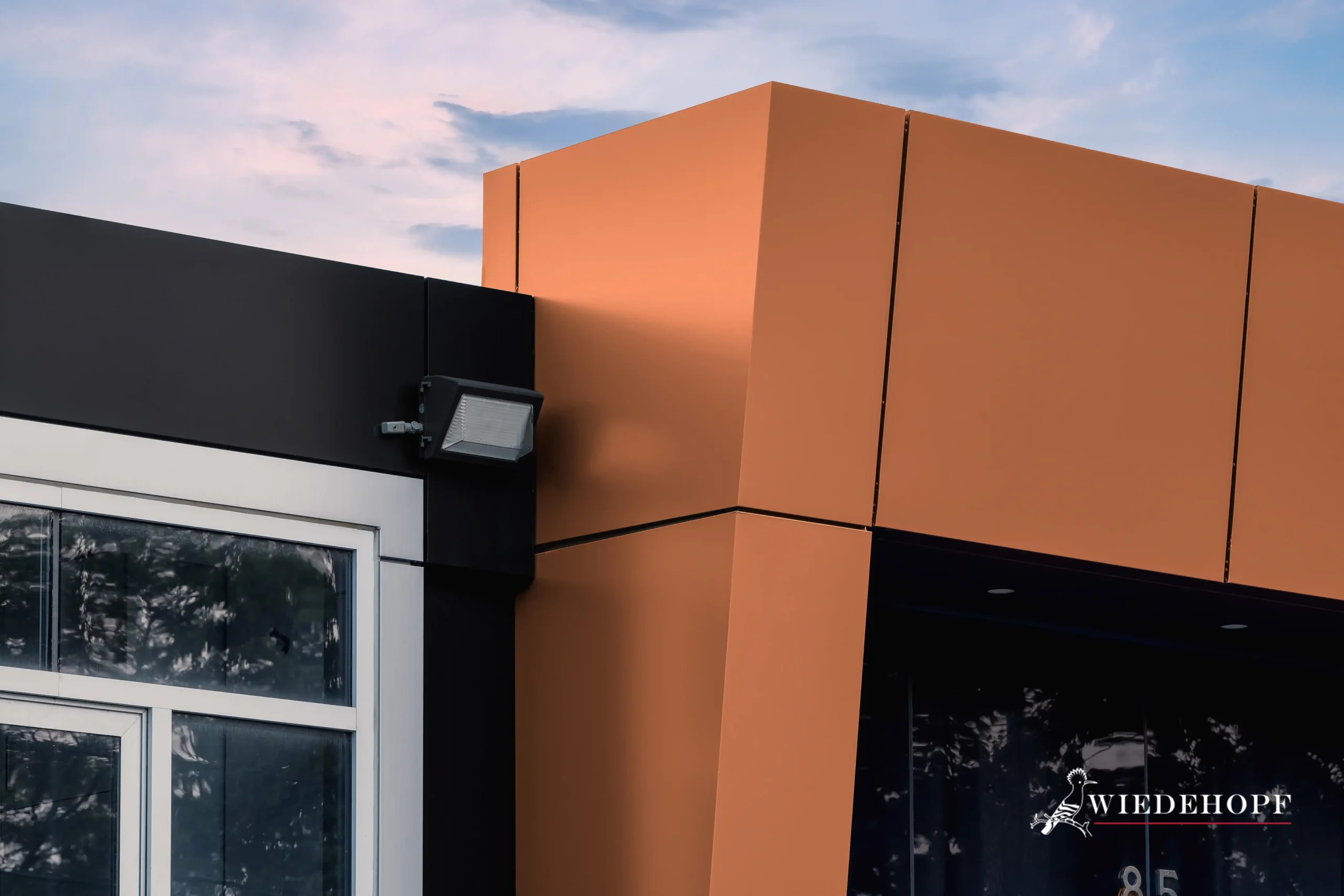 Quick Answer: What Does ACP Mean?
ACP stands for aluminum composite panel.
An ACP is typically made from:
- One exterior aluminum skin
- One central core
- One interior aluminum skin
- Bonding layers
- A factory-applied decorative coating
- A temporary protective film
The aluminum skins create the visible metal surfaces, while the core separates the skins and gives the panel its overall thickness. Together, these layers produce a material that can provide good flatness with relatively low weight.
ACP is primarily used as a non-load-bearing architectural finish. It does not normally support the building in the way that structural steel, concrete, or load-bearing walls do.
However, the complete panel system must still be designed to resist wind, movement, impact, and environmental exposure. The rails, brackets, fasteners and anchors behind the panels transfer those loads to the building structure.
ACP, ACM and MCM: What Is the Difference?
ACP, ACM and MCM are closely related terms, but they do not always mean exactly the same thing.
| Term | Full form | Common meaning |
|---|---|---|
| ACP | Aluminum composite panel | A finished or usable aluminum composite panel |
| ACM | Aluminum composite material | The composite sheet material before or after fabrication |
| MCM | Metal composite material | A broader category of composite panels with metal skins |
| ACM cladding | Aluminum composite material cladding | A complete wall-covering application using ACM panels |
In everyday Canadian construction language, ACP and ACM are frequently used as synonyms. A contractor may refer to an “ACP panel,” while a supplier may describe the same general product category as “ACM sheet” or “ACM material.”
MCM is a broader technical category. It can include composite materials faced with aluminum or other metals, depending on the product and specification.
What Is ACP in Construction?
In construction, ACP is mainly used as a cladding and finishing material. It is installed over a supporting wall, framing system or substructure to create the visible surface of a building.
The finished panels may help protect the underlying wall from direct exposure to rain, snow, wind and sunlight. However, ACP is normally only one component of a larger building-envelope system.
A typical exterior ACP wall may include:
- Fabricated ACP panels
- Clips, brackets, or rails
- A supporting subframe
- Fasteners and anchors
- An air space or drainage cavity
- Exterior insulation
- An air and vapour control layer
- Sheathing
- Flashing
- Sealants or gaskets
- Cavity barriers or fire-stopping components
The exact arrangement depends on the building type, panel system, wall design, and local requirements.
This is why ACP should not be selected based only on colour or price. The panel, attachment system, and wall behind it must work together as a coordinated exterior assembly.
For an overview of available materials, colours, and supply options, you can visit Wiedehopf’s aluminum composite panel page.
What Is ACP Cladding?
ACP cladding is a wall-covering system made from aluminum composite panels attached to a building façade, subframe or supporting surface.
The flat sheets are usually measured, cut and fabricated into project-specific shapes. For many architectural systems, the back of the sheet is routed so the edges can be folded into a tray or cassette.
The fabricated panel is then attached using clips, rails, brackets, rivets, screws or other approved components.
The visible panel creates the architectural finish. The components behind it help manage:
- Panel alignment
- Attachment
- Wind loads
- Drainage
- Ventilation
- Thermal movement
- Interfaces with windows and doors
A well-designed ACP system should not be viewed as a decorative skin alone. It is part of the building’s exterior wall strategy.
Wiedehopf’s ACM panel installation guide provides additional information about design coordination, fabrication, and installation.
What Are ACP Panels Made Of?
An ACP panel has a sandwich-like construction. The exact materials and dimensions vary, but most panels share the same basic structure.
Aluminum face sheets
The exterior and interior faces are made from thin aluminum sheets. The outer sheet receives the visible finish, while the inner sheet is normally concealed after installation.
The thickness of these sheets can affect:
- Panel rigidity
- Impact resistance
- Fabrication behaviour
- Surface appearance
- Allowable panel size
Two panels with the same total thickness may have different skin thicknesses, so the overall dimension alone does not provide enough information for comparison.
Central core
The central layer is the core of the composite panel. It separates the aluminum skins and contributes to the panel’s thickness, stiffness, weight and fire behaviour.
Possible descriptions include:
- Polymer core
- Polyethylene or PE core
- Mineral-filled core
- Fire-retardant core
- Mineral-dominant core
- Limited-combustibility core
These terms should not be treated as automatically equivalent. The exact product data and supporting documentation should always be reviewed.
Bonding layers
The aluminum sheets and core are held together with bonding or thermally activated adhesive layers.
Reliable bonding is important because delamination can affect appearance and performance. Panels should be fabricated and installed according to the product manufacturer’s requirements.
Decorative coating
The visible aluminum surface normally receives a factory-applied coating or finish.
Available appearances may include:
- Solid colours such as black and gray
- Metallic colours
- Mica finishes
- Matte finishes
- High-gloss finishes
- Wood-look patterns
- Stone-look patterns
- Brushed-metal effects
- Custom colours
The coating should be suitable for the intended exposure. Exterior façades in the GTA experience sun, rain, freezing temperatures, snow, road salt and seasonal temperature changes, so an exterior-rated finish is important.
Protective film
Many ACP sheets arrive with a temporary protective film over the finished face.
This film protects the surface during transportation, cutting, routing and installation. It should be removed at the appropriate time, because prolonged exposure can make removal more difficult.
Common ACP Core Types
The core is one of the most important differences between ACP products. It affects weight, fabrication, classification and fire behaviour.
| Core category | General description | Typical consideration |
|---|---|---|
| Polymer-dominant core | Contains a high proportion of polymer | May face restrictions in exterior applications |
| Mineral-filled core | Combines mineral ingredients with a binder | Product-specific fire documentation is required |
| Mineral-dominant core | Contains a higher proportion of mineral material | Often considered for stricter fire-performance needs |
| A2-classified core | Designed for a particular European reaction-to-fire classification | Classification must be verified for the exact product |
| Solid aluminum alternative | Not a conventional composite-core panel | Different weight, cost and engineering requirements |
Polymer-core ACP
A polymer-core ACP normally contains a high proportion of polyethylene or another polymer.
These panels can be lightweight and easy to fabricate. However, their combustible content means that their use may be restricted depending on the building and jurisdiction.
A polymer-core panel should not be chosen for an exterior project simply because it is less expensive or readily available. The design team must confirm that the product is permitted for the intended application.
Mineral-filled ACP
A mineral-filled panel uses mineral ingredients combined with a binder.
These panels are generally designed to provide improved fire behaviour compared with polymer-dominant products. However, the phrase “mineral-filled” does not by itself confirm that a product is non-combustible or suitable for every building.
The product’s:
- Core formulation
- Classification
- Test reports
- Panel thickness
- Approved applications
- Assembly details
should all be reviewed.
Mineral-dominant ACP
A mineral-dominant core contains a larger proportion of mineral material and a smaller amount of binder.
These products may be considered where stricter fire-performance criteria apply. The exact classification depends on the test method and the specific product.
A2 ACP
The term A2 refers to a European reaction-to-fire classification.
It should not be used as a casual synonym for every mineral-core product. When an A2 panel is specified, the documentation should confirm the classification of the exact product being supplied.
Solid aluminum
Solid aluminum sheet or plate contains no conventional composite core.
It may be considered as an alternative to ACP for some applications, but it is not a direct substitute in every situation. Solid aluminum can have different:
- Weight
- Stiffness
- Reinforcement needs
- Panel dimensions
- Fabrication methods
- Costs
- Fire characteristics
An architect or engineer should review substitutions before they are approved.
Is ACP Combustible?
ACP is not automatically combustible or non-combustible as a category. Its fire behaviour depends largely on the core and on the complete wall assembly.
A polymer-dominant panel may behave differently from a mineral-dominant panel. Even so, the panel is only one part of the exterior wall.
Other relevant components can include:
- Insulation
- Membranes
- Sheathing
- Air cavities
- Subframe components
- Window details
- Fire barriers
- Sealants
- Fasteners
- Backing walls
For this reason, it is inaccurate to say that an entire wall is safe based only on the name or marketing description of one panel.
A responsible evaluation should confirm:
- The exact product
- The precise core type
- The applicable test reports
- The approved wall configuration
- The project’s building type
- The applicable Ontario and local requirements
- Any limitations listed in the product documentation
Property owners and contractors should avoid broad claims such as “all ACP is fireproof” or “every mineral panel is non-combustible.”
For general Canadian model-code information, consult the National Research Council of Canada’s Codes Canada resources.
For Ontario projects, the project team should also review the Ontario Building Code and any applicable local requirements with qualified professionals.
Is ACP Suitable for High-Rise Buildings?
Some ACP systems may be suitable for high-rise construction, while others may not be.
The answer depends on:
- Building height
- Occupancy
- Construction type
- Core composition
- Wall assembly
- Insulation
- Fire tests
- Code requirements
- Local approvals
A product that is acceptable for a small entrance feature may not be acceptable for an entire high-rise exterior.
The phrase “high-rise suitable” should always be supported by project-specific documentation. Designers should review the exact panel and wall assembly rather than relying on a general brochure.
For people researching historical and international ACM-cladding safety issues, the UK government maintains an aluminium composite material cladding guidance page.
That external resource provides useful background, but it does not replace Canadian or Ontario requirements.
Common Uses of ACP
ACP is valued for its flexibility, which makes it suitable for many commercial and residential design applications.
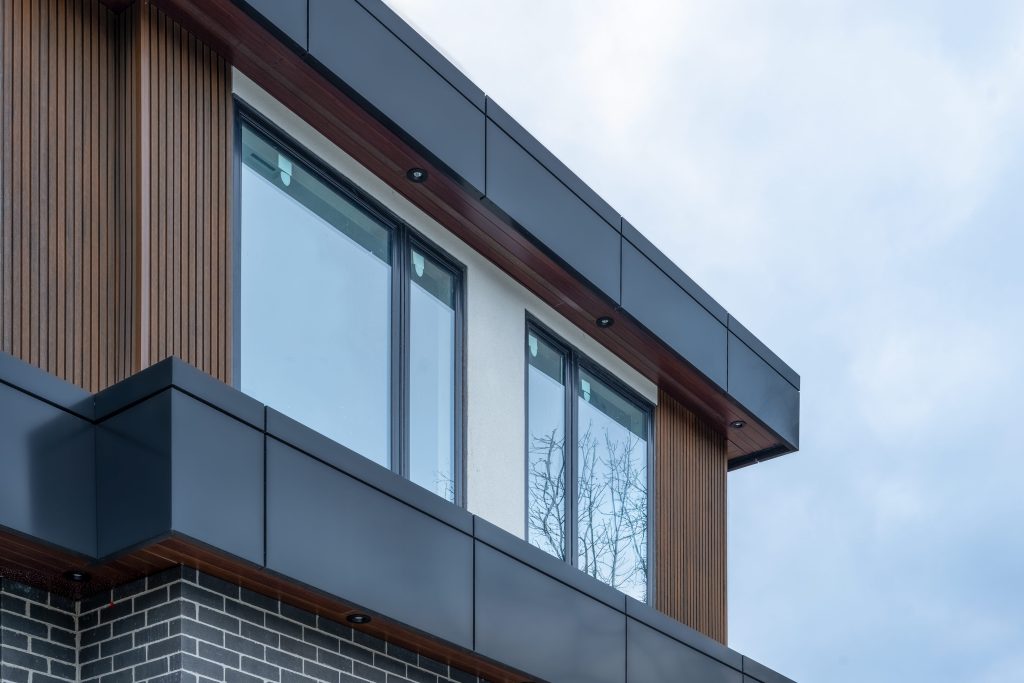
Exterior building façades
The most recognizable application is exterior façade cladding.
ACP can create large, smooth surfaces with clean joints. It is often used on:
- Commercial buildings
- Schools
- Retail stores
- Office buildings
- Restaurants
- Automotive dealerships
- Multi-unit residential buildings
- Institutional facilities
Wiedehopf’s North York school façade project shows how white ACM panels can be used to create a clean, modern exterior.
Entrances and storefronts
ACP is commonly used to create prominent entrances and storefront frames.
The material can form projecting bands, deep returns and contrasting colour blocks. This makes it useful for brand-focused commercial architecture.
Column cladding
Round, square or rectangular columns can be covered with custom-fabricated ACP panels.
Column applications require careful measurement and joint planning, especially where curved or segmented panels are involved.
Canopies
ACP can be used on canopy fascias, soffits and entrance features.
These locations often require coordination with lighting, drainage, roofing, signage and structural supports.
Soffits
A soffit is the underside of a roof edge, overhang or canopy.
ACP can create a smooth and low-maintenance soffit surface, provided the selected panel and attachment method are appropriate for overhead installation.
Parapets and roof edges
ACP can be fabricated for parapet faces and roof-edge bands.
These locations require careful flashing because they often meet roofing membranes and coping systems.
Interior wall features
ACP can also be used for interior decorative applications, including:
- Reception walls
- Retail displays
- Elevator surrounds
- Feature columns
- Corporate interiors
- Exhibition spaces
Interior requirements may differ from exterior requirements, so the selected product should be approved for its intended use.
Signage
The material’s smooth surface makes it popular for sign panels, lettering backgrounds and branded architectural elements.
Signage applications may use different sheet sizes, thicknesses and fabrication methods than full exterior cladding systems.
Renovation and recladding
Older façades can sometimes be updated with a new ACP or ACM cladding system.
Before recladding, the project team should investigate:
- Existing wall conditions
- Moisture damage
- Substrate strength
- Attachment capacity
- Window interfaces
- Roof connections
- Fire strategy
- Drainage paths
A new panel should not simply conceal unresolved problems behind the existing façade.
Types of ACP Cladding Systems
ACP panels can be installed in several system configurations. Each approach has different joint, drainage and attachment characteristics.
Rout-and-return cassette system
A rout-and-return system begins with a flat ACP sheet.
A groove is cut into the back while leaving the exterior face intact. The edges are then folded to form a tray or cassette.
The panel may be attached using concealed clips, rails or brackets.
Common benefits include:
- Clean panel edges
- Concealed fasteners
- Consistent joints
- Custom panel shapes
- Potential panel replacement
The routing depth and folding process must follow the product and system requirements.
Rainscreen system
A rainscreen system places the ACP panels in front of a drained and ventilated cavity.
The outer panels reduce direct rain exposure, while water that enters the joints can drain behind the cladding.
A rainscreen normally relies on the backup wall for essential air and water control. The panel face alone should not be assumed to make the wall waterproof.
Face-fastened system
A face-fastened system uses visible screws or rivets.
This approach can be practical for certain commercial, industrial or institutional designs. The fastener pattern should be coordinated with the panel dimensions and expected movement.
Sealed-joint system
A sealed-joint system uses sealant at the panel joints to resist water entry.
Joint design, sealant selection and surface preparation are critical. Sealants also require future inspection and replacement.
Dry-joint system
A dry-joint system may use gaskets, baffles, overlapping profiles or concealed drainage components rather than a continuous exposed sealant joint.
Dry-joint systems can create a crisp appearance, but the exact water-management strategy should be understood before construction.
| System type | Main characteristic | Typical consideration |
|---|---|---|
| Cassette system | Folded trays with concealed attachment | Requires accurate fabrication |
| Rainscreen system | Drained cavity behind panels | Backup wall remains essential |
| Face-fastened system | Visible rivets or screws | Movement and fastener layout |
| Wet-seal system | Exposed sealed joints | Sealant maintenance |
| Dry-joint system | Gaskets or baffled joints | Drainage and system-specific details |
How ACP Panels Are Fabricated
ACP fabrication turns flat sheets into project-specific architectural panels.
The process usually begins after design dimensions and field conditions have been reviewed.
1. Site measurement
Accurate field measurements help identify real construction tolerances.
Existing walls are not always perfectly straight, level or square, so field verification can prevent panel-fit problems.
2. Shop drawings
Shop drawings show:
- Panel sizes
- Joint locations
- Folded returns
- Attachments
- Subframe elements
- Flashings
- Corners
- Window and door interfaces
These drawings coordinate the panel system with the rest of the building.
3. Sheet optimization
Fabricators arrange panel shapes across the available sheets to reduce unnecessary waste.
Finish direction must also be considered. Metallic and wood-look patterns may appear inconsistent when adjacent sheets are rotated.
4. Cutting
The material is cut using suitable tools or computer-controlled fabrication equipment.
Accurate cutting supports consistent panel sizes and joint widths.
5. Routing
Grooves are machined into the rear surface where folds are needed.
The goal is to leave enough material at the face to create a clean fold without damaging the visible surface.
6. Folding
Routed edges are folded into returns to form cassettes, trays, corners or custom shapes.
7. Reinforcement
Larger panels may require stiffeners or reinforcing components.
The need for reinforcement depends on panel dimensions, skin thickness, wind loads and the selected system.
related links: How Strong is Aluminum Composite Panel?
8. Quality control
Before delivery, panels should be reviewed for:
- Dimensions
- Squareness
- Finish direction
- Surface damage
- Routing accuracy
- Corner assembly
- Labelling
- Installation sequence
For more detail, read Wiedehopf’s guide to the installation process for aluminum composite panels.
How ACP Cladding Is Installed
ACP installation begins long before the first panel is attached.
The substrate, membranes, subframe and interface details must be prepared before the visible cladding is completed.
A typical installation sequence may include:
- Inspecting the substrate
- Confirming layout lines
- Installing brackets
- Installing rails or framing
- Coordinating insulation and membranes
- Adding required fire barriers
- Installing flashings
- Attaching the panels
- Adjusting alignment
- Completing joints
- Removing protective film
- Inspecting the finished work
The precise order depends on the selected system.
Substrate inspection
The installer checks the wall for alignment, strength and readiness.
Problems behind the panels should be corrected before they are concealed.
Layout
Control lines establish panel positions and joint spacing.
Small layout errors can become visually obvious when repeated across a large façade.
Subframe installation
Brackets and rails create the support structure behind the panels.
The subframe may also provide space for insulation, drainage and ventilation.
Panel attachment
Panels are installed in the planned sequence and adjusted to maintain consistent alignment and joint widths.
Joint completion
Depending on the system, joints may receive sealant, gaskets, baffles or closure profiles.
Final inspection
The completed façade should be reviewed for:
- Panel alignment
- Surface damage
- Joint consistency
- Loose components
- Incomplete seals
- Protective film
- Cleanliness
Advantages of ACP
ACP offers several practical and visual benefits, which explain its widespread use.
Low weight
ACP is generally lighter than many masonry, precast, and thick solid-metal alternatives.
Lower weight can simplify transportation and handling, although the final system must still be properly engineered.
Design flexibility
ACP can be fabricated into:
- Flat panels
- Curved forms
- Columns
- Canopies
- Soffits
- Angular shapes
- Reveals
- Decorative bands
- Custom features
This flexibility allows one material family to be used across several areas of a building.
Clean appearance
The panels can create smooth surfaces and consistent joint patterns.
This appearance works particularly well for contemporary homes and commercial buildings in the GTA.
Broad colour selection
ACP is available in a wide range of finishes, allowing designers to combine:
- Neutral greys
- Black
- White
- Metallic silver
- Bronze
- Wood-look colours
- Corporate brand colours
Wiedehopf’s in-stock supply can help Toronto-area customers access popular panel colours without waiting for every sheet to be produced as a special order.
Off-site fabrication
Panels can be measured and fabricated in a controlled shop environment.
This can support accurate panel production and more organized site installation.
Potential for individual replacement
Some systems allow damaged panels to be removed without replacing the entire façade.
However, replacement panels may not perfectly match weathered material, so retaining extra panels from the original batch may be useful.
Limitations and Design Considerations
ACP should be selected with a clear understanding of its limitations.
Impact damage
Thin aluminum faces can be dented by carts, equipment, vandalism or construction activity.
Ground-level areas may need:
- Thicker skins
- Smaller panels
- Additional reinforcement
- Protective barriers
- A more impact-resistant material
Thermal movement
Aluminum expands and contracts as temperatures change.
GTA buildings experience hot summers and freezing winters, so joints and fasteners must allow movement without buckling or overstressing the panels.
Sealant maintenance
Wet-seal systems depend on exposed sealants.
These joints should be inspected and replaced when they show cracking, separation or deterioration.
Finish variation
Metallic and patterned coatings can appear different depending on orientation, lighting and production batch.
Installation arrows and finish direction should be followed carefully.
Interface details
Windows, doors, parapets, roofs and transitions to other materials are among the most critical areas.
Careful detailing is required to prevent water intrusion and premature deterioration.
ACP Compared With Other Cladding Materials
ACP is only one of many available exterior materials.
| Material | Main benefit | Main consideration |
|---|---|---|
| ACP or ACM | Lightweight and highly formable | Core and assembly selection |
| Solid aluminum | No conventional composite core | May require thicker metal or reinforcement |
| Aluminum siding | Familiar and efficient installation | Different visual scale and detailing |
| Insulated metal panel | Cladding and insulation combined | Joint and core requirements |
| Fibre cement | Durable panel appearance | Weight and edge treatment |
| High-pressure laminate | Wide decorative selection | Product-specific exterior and fire ratings |
| Terracotta | Natural colour and long-term visual character | Higher weight and specialized support |
| Brick veneer | Traditional appearance | Structural support and installation time |
| WPC cladding | Warm, wood-like appearance | Expansion, fading and product quality |
The correct choice depends on:
- Architectural goals
- Building type
- Budget
- Fire requirements
- Maintenance expectations
- Impact exposure
- Availability
- Installation schedule
Related Link: Aluminum Composite Panel Compared to Other Construction Materials
ACP Versus Solid Aluminum
ACP and solid aluminum can create similar-looking façades, but their construction is different.
ACP uses two thin aluminum skins separated by a core. Solid aluminum uses one continuous piece of metal.
| Comparison point | ACP | Solid aluminum |
|---|---|---|
| Construction | Composite sandwich panel | Single metal sheet or plate |
| Weight | Generally lower | Often higher |
| Flatness | Good relative to weight | Depends on thickness and reinforcement |
| Fabrication | Easy to route and fold | Requires metal-forming processes |
| Core | Polymer or mineral-based | No composite core |
| Cost | Product and system dependent | Often higher for thicker plate |
| Engineering | System-specific | System-specific |
Neither material is automatically better.
The choice should be based on project performance, appearance, cost, fabrication and code requirements.
Choosing ACP for a GTA Project
Toronto and GTA projects face specific practical conditions, including freeze-thaw cycles, wind, summer heat, snow, rain and road-salt exposure.
Before purchasing panels, consider the following questions.
Is the panel rated for exterior use?
An exterior panel should have an appropriate coating and product specification.
Interior sign material should not be assumed suitable for a building façade.
Is the core appropriate?
Confirm the exact core type and supporting documentation.
Do not rely only on labels such as “FR,” “fire-rated” or “mineral.”
Is the panel available?
Availability can affect the construction schedule.
Wiedehopf’s primary local advantage is that ACM panels are stocked in the Toronto area and ready to ship, subject to colour, quantity and current inventory.
Is the finish suitable?
Review a physical sample before final approval.
Computer screens do not accurately reproduce every metallic, gloss or textured finish.
Can replacement material be obtained?
Consider whether the colour and product are likely to remain available.
For larger projects, retaining attic stock may help with future repairs.
Who will fabricate the panels?
Accurate fabrication affects:
- Joint consistency
- Corner quality
- Surface appearance
- Installation speed
- Material waste
Who will install the system?
Installation experience matters because ACP requires coordination between the visible panels and the hidden wall components.
Has the system been reviewed by qualified professionals?
Architects, engineers, building-envelope consultants and code professionals should review the project where their services are required.
In-Stock ACP Panels in Toronto and the GTA
Long material lead times can delay fabrication and installation.
Wiedehopf offers ACM panels in stock and ready to ship from the Toronto area, helping eligible residential, commercial and fabrication customers reduce unnecessary procurement delays.
Local availability can be particularly valuable for:
- Time-sensitive renovation projects
- Commercial storefront updates
- Replacement panels
- Fabrication shops
- Contractors with active GTA projects
- Small and medium façade packages
- Customers comparing physical colours before ordering
Available inventory can change, so customers should confirm:
- Colour
- Finish
- Sheet dimensions
- Panel thickness
- Core type
- Quantity
- Pickup or delivery options
To check current stock, request samples or discuss an upcoming project, visit Wiedehopf’s contact and quotation page.
ACP Maintenance
ACP façades generally require limited routine maintenance, but they should not be ignored.
Periodic inspection can identify minor problems before they develop into more expensive repairs.
Inspect for:
- Dents
- Scratches
- Loose panels
- Open joints
- Cracked sealant
- Staining
- Corrosion
- Water-entry evidence
- Damaged flashings
- Movement at transitions
Cleaning methods should follow the manufacturer’s recommendations.
Avoid using:
- Highly abrasive pads
- Unknown chemical cleaners
- Aggressive solvents
- Improper pressure-washing techniques
- Metal scrapers
A cleaning product should be tested in a small, inconspicuous area first.
Frequently Asked Questions
What does ACP stand for?
ACP stands for aluminum composite panel. It is a layered architectural panel made from two aluminum sheets bonded to a central core.
What does ACP mean in construction?
In construction, ACP refers to aluminum composite panels used for cladding and architectural finishes. Common applications include façades, columns, canopies, soffits and interior feature walls.
What is ACP cladding?
ACP cladding is a building-surface system made with fabricated aluminum composite panels. The panels are attached to a supporting wall or subframe.
Is ACP the same as ACM?
ACP and ACM are commonly used interchangeably. ACP means aluminum composite panel, while ACM means aluminum composite material.
Is ACP a structural product?
ACP is generally non-load-bearing. It functions as a cladding or finish rather than the building’s main structural wall.
Is ACP waterproof?
The panel surface is water-resistant, but the complete wall is not automatically waterproof. Joints, flashings, membranes and drainage components must manage water.
Is ACP combustible?
The answer depends on the panel core and wall assembly. Polymer-core, mineral-filled and mineral-dominant panels can have different fire behaviour.
Is mineral-filled ACP non-combustible?
Not necessarily. The term mineral-filled does not by itself establish non-combustibility. Review the exact classification and supporting documentation.
What is ACP work?
ACP work includes measuring, designing, cutting, routing, folding, fabricating and installing aluminum composite panels.
What is an ACP cassette?
An ACP cassette is a folded panel tray made by routing and bending the edges of a flat sheet.
Can ACP be used on houses?
ACP can be used on residential buildings, including entrances, additions, accent walls, garages and contemporary façades, subject to project requirements.
Can ACP be used on commercial buildings?
Yes, commercial construction is one of the most common ACP applications. Retail, office, restaurant, school and institutional buildings frequently use ACM façade systems.
Can ACP be installed over an existing wall?
Sometimes, but the existing wall must be evaluated first. The substrate, moisture conditions, attachment capacity and wall design should be reviewed.
How thick is ACP?
ACP is produced in several thicknesses. Total panel thickness alone does not identify skin thickness, strength, core type or fire performance.
Can ACP panels be curved?
Yes, some ACP panels can be curved or segmented, depending on the product, radius and fabrication method.
Does ACP fade?
Exterior coatings are designed to resist weathering, but all finishes can change over time. The coating type, colour, exposure and maintenance affect long-term appearance.
Can one damaged panel be replaced?
Individual replacement is possible in many systems, although access and colour matching can be challenging.
Is ACP suitable for Canadian weather?
Properly selected and installed ACP systems can be used in Canadian climates. Coating, movement, drainage, attachment and detailing must suit the exposure.
Where can I buy ACM panels in Toronto?
Wiedehopf supplies in-stock ACM panels for customers in Toronto and the GTA. Customers can request current colour, size, core and quantity information before ordering.
Why Buy ACM Panels From Wiedehopf?
Wiedehopf supports GTA customers with local product knowledge, material supply and project experience.
The company’s main advantage is straightforward: ACM panels are stocked locally and ready to ship, helping contractors, fabricators, designers and property owners keep projects moving.
Wiedehopf can help customers with:
- ACM panel supply
- Available colour selection
- Material samples
- Custom fabrication
- Shop-drawing coordination
- Cladding installation
- Commercial façade projects
- Residential exterior projects
- Replacement panels
- GTA delivery and pickup coordination
You can review our real projects in Wiedehopf’s portfolio.
Final Thoughts
ACP is a versatile and widely used architectural material, but it is not one uniform product.
Different panels can have different:
- Core compositions
- Skin thicknesses
- Coatings
- Dimensions
- Classifications
- Fabrication requirements
- Approved applications
The best results come from selecting the panel as part of a complete and coordinated cladding system.
For people new to the material, the most important points are simple:
- ACP means aluminum composite panel
- ACM is a commonly used alternative term
- ACP is mainly a cladding and finishing material
- Core types are not all the same
- The full wall assembly matters
- Professional design and installation are important
- Local material availability can reduce project delays
For Toronto and GTA projects, Wiedehopf provides in-stock ACM panels ready to ship, along with fabrication, installation and project-support services.
Visit the Wiedehopf ACM panel page to explore the material, or contact Wiedehopf to check current inventory, request samples or discuss an upcoming project.

1 Comment. Leave new
I appreciated the detailed breakdown of the features and benefits of ACP Cladding. It’s clear that it offers a wide range of advantages, from durability to customization options. I wonder if there are any specific case studies or real-life examples of projects where ACP cladding was particularly effective?